
Before you buy more leads, get more revenue from the ones you already have.
Your store already knows what to do with every customer. DSE puts that judgment on every lead, every day, whether the one answering is you, your manager, or your BDC. And it never guesses on your behalf.
Built on 8+ years of in-store dealership AIOne flat rateMonth-to-month
A purchase this big turns on small things. Like how long a buyer has been waiting on you.
- BBB A+ Accredited
- 5.0 / 5 Rating
- Serving high-ticket businesses since 2017
- 300+ campaigns deployed
You've been pitched "AI for your leads" before.
Every pitch was features. Every feature pitch ends in the same bucket: one more texting tool, priced by the month, judged by volume.
You know how those go. The bot quotes a payment your deal can't hit, and your desk walks it back. It tells a buyer the car is still here the morning after it sold, and they drive forty minutes for nothing. And the vendor bills by the message, so pestering your customers is how they get paid.
Cars sell on the small stuff. Did this buyer already start an application? How long have they been waiting on you to answer? One sharp owner or manager holds that for a handful of leads. Nobody holds it for all of them, at 7:41 on a Saturday night.
Here's the part most vendors leave out of the pitch: what the machine does when it doesn't know.
More leads won't fix an inconsistent process. They make the leak more expensive.
You already pay for leads: your site, Facebook, the third-party feeds. Paying for a lead doesn't make it worth anything. The value shows up after it arrives.
How fast someone answers. How long the follow-up keeps going. Whether anyone can tell which customers mean it. Whether the application gets finished. Whether the right person knows the moment a customer needs a person.
When that process is inconsistent, more leads just push more money through the same leak.
DSE gets more out of the leads you already have.
What's it worth to put your best GSM on every single lead? That's the whole idea.
Two lots. One machine.
20 to 50 cars a month. Buy here pay here, or independent.
You're the closer. Leads come from Marketplace, your site, and a few you pay for. After six the phone goes quiet, and the 7:41 text gets its answer at eleven the next morning. You need that text answered fast, without a made-up number, so the buyer is still yours by breakfast.
80-plus on the ground.
One rooftop, an internet manager or one BDC person under water. CarGurus, OEM leads, and a chat tool that once quoted a payment the desk had to eat. You need the longest-waiting buyer at the top of one board, and a machine that never types a figure it can't stand behind.
Same machine. Same rules. Same screens.
When we can't know something honestly, we show you a blank, not a guess.
A number lands on your screen only when it traces back to a record. When it can't, the tile stays blank. So every number you do see is one you can trust.
Before we let it write a single fact on a customer's record on its own, it has to beat hundreds of real customer replies we labeled by hand. It hasn't cleared that bar yet. So today it flags, and your team decides.
That's what it won't do. Here's what it will, starting with the price, the payment, and the car itself.
Proof, not promises. Three rules it keeps.
It never quotes a customer a price, a payment, or a car it can't stand behind.
When it's texting a customer back and forth, it can't type a price or a payment itself. It writes with the number left blank, and your own records fill in the real figure the instant before the text goes out. Ask it whether a car is still on the lot, and it won't promise yes. It says the car is showing available on your list, and it only invites a customer in during your real open hours.
And right before any message goes out, the automatic ones too, a final check reads the finished text and stops it if it promises an approval or swears a car is on the lot.
That's the rule because a walked-back payment costs you the deal and the customer.

When it's sure, it moves. When it's not, it hands it to your team.
Most texts don't need you. A customer texts, it answers, usually in about fifteen seconds. It never texts before 8 in the morning or after 9 at night, your time. If the reply names a time to come in, it checks that time against your posted hours first. When a customer asks for a real person, or your team steps in, it stops and hands the lead over on the spot.
It can't even tell a customer "someone will call you back" unless it has already made that a real job on your board. And it never writes a customer's answer into your record on a guess. When a reply isn't clear-cut, it flags it for your team instead of deciding for you. A wrong guess would put something false on your record.
It would rather ask your team than guess, and it's being taught to ask less. And your store gets a text or an email the moment it hands one off.

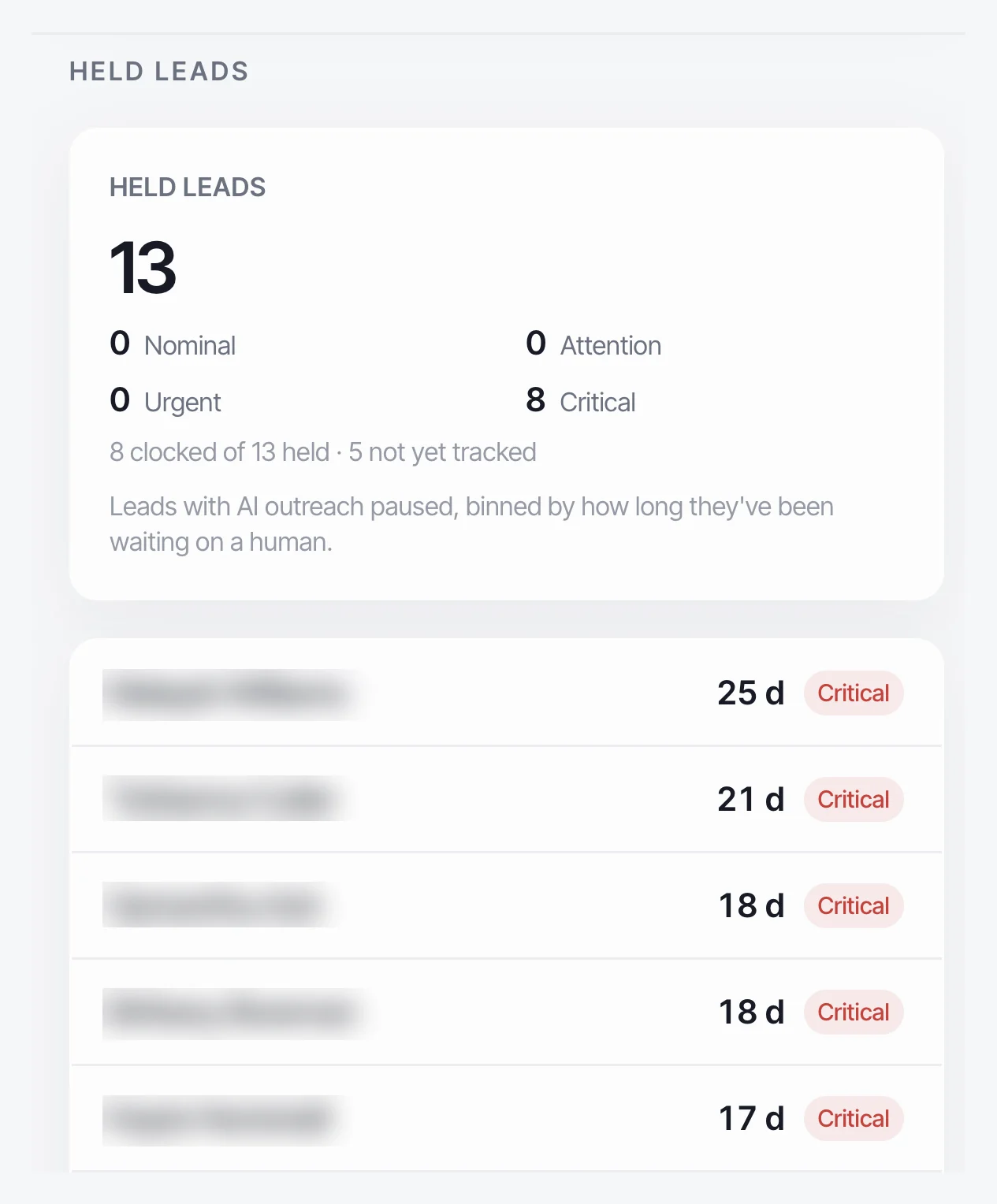
Every customer waiting on your team is on one board, with a clock running.
Who's waiting on your team, and for how long, at a glance. The one who's waited longest sits right at the top, so the first call of the morning is never a guess.
The clock starts the second it hands a lead to a person. So the number is the customer's wait, not an estimate of it.
And that's just the board. Here's what it does the rest of the day.
When nobody's watching. What it does all day.
Big promises are easy to make. These are the small habits that keep them, and you can watch every one on your own screen.
- It never says "see you at six" when you close at five. Any time it offers gets checked against your posted hours first.
- It holds a scheduled text if that customer is already mid-conversation, booked, or paused, so your automated messages don't talk over a live one.
- It can't tell a nervous buyer "you're approved." A separate check reads every outgoing message and strikes any promise of an outcome before it sends.
- Your web funnel stops congratulating everyone. It runs your actual rules and gives an honest answer, so a borderline buyer arrives ready to talk instead of angry at your desk.
- When a buyer's ready, it sends them your credit-application link, and the moment the buyer says it's done, it puts the lead on your list to record the decision.
- Every note your team writes and every text they send by hand carries when it happened, and hand-sent texts are marked as yours, not the machine's.
- When a lender approves, counters, or declines, your team records it in one click: who, when, on what terms. A permanent record the credit numbers on your board trace back to.
We didn't design these rules. We learned them the hard way, at one failing dealership, back in 2017.
We did this by hand at one dealership for five years.
$25M+
It started in 2017 with a dealership that was failing.
We answered fast. That was never the hard part.
The hard part was reading every conversation the way the store's best manager would. And one manager can only hold so many buyers in their head. That's the wall every store hits, and it's the reason every rule above exists.
Working alongside the store's own team, that store grew to $25M+ in annual revenue.
DSE is that attention, made permanent.
See the case studyNone of it asks you to rip anything out.
Runs alongside what you already have. One flat rate.
DSE doesn't replace your CRM or your DMS. It runs the follow-up in between. Nothing to rip out.
One flat monthly rate. No per-lead fees. No per-message fees. Flat, because this machine's job is to say less, not more. Pay by the message and you're paying a vendor to pester your customers.
Month to month. Then decide.
One flat monthly rate, month to month, thirty days' notice. No long-term contract. We earn it every month or you walk. Priced off a car a month, not off enterprise software. We'll walk through current pricing on the call.
We do the setup.
Getting a store live takes real work on our side: your hours, your inventory feed, your financing rules, your texting line registered in your dealership's name. We do all of it. The texting registration goes through the carriers and takes a week or more, so we start it on day one.
Then we keep tuning it.
A named strategist owns your store's setup and keeps adjusting it while DSE watches itself for anything slipping. We mystery-shop your store with test leads, so you see what your customers see. No status meetings. When we sit down, it's to break your next bottleneck.
A fair warning. DSE is not for every dealership.
It's built for stores that
- get real lead volume from the website, Meta, or third-party feeds
- have a working sales floor
- have someone who will take a handoff
- will record credit decisions and send replies through DSE
- want an honest view of what's happening
It's probably not for stores that
- want a cheap texting bot
- expect software to guarantee sales
- won't answer when a customer needs a person
- won't keep outcomes and credit decisions current
- need it to fix everything at once
A DSE store doesn't have to be perfect. It has to act when the board says a customer is waiting.
The walkthrough. A short call. Then you decide.
It's Alex and Matt: the founder and a retired general sales manager. Your gut will know early whether it fits.
First we walk how leads move through your store today: where they come from, how fast they get answered, how follow-up is handled, how applications get pursued, and where opportunities go quiet.
Then we open the real product, on a demo account, and you watch it work. A new lead coming in. The conversation it has. What it captures. The moment it hands a customer to a person. The Command Center. The Held Leads board.
The real product, working live. No screenshots of a product that doesn't exist. No private customer conversations.
Then you decide. If it fits, we start your setup on the call. If DSE isn't a fit for your store, we'll say so.
Some of your leads are waiting on a response right now.
Others got one reply and disappeared into a task list. Some started a credit application and never finished it. Some haven't given your team a reason to prioritize them yet. And some are closer to buying than your store realizes.
We built DSE to back up our words. Come see if it backs up yours.
P.S. Bring the one question the last vendor dodged. Alex and Matt open the real product live and either show you the screen that answers it, or tell you straight that we can't. It only shows a number it can trace to a record. So the worst we can do is show you the blank.